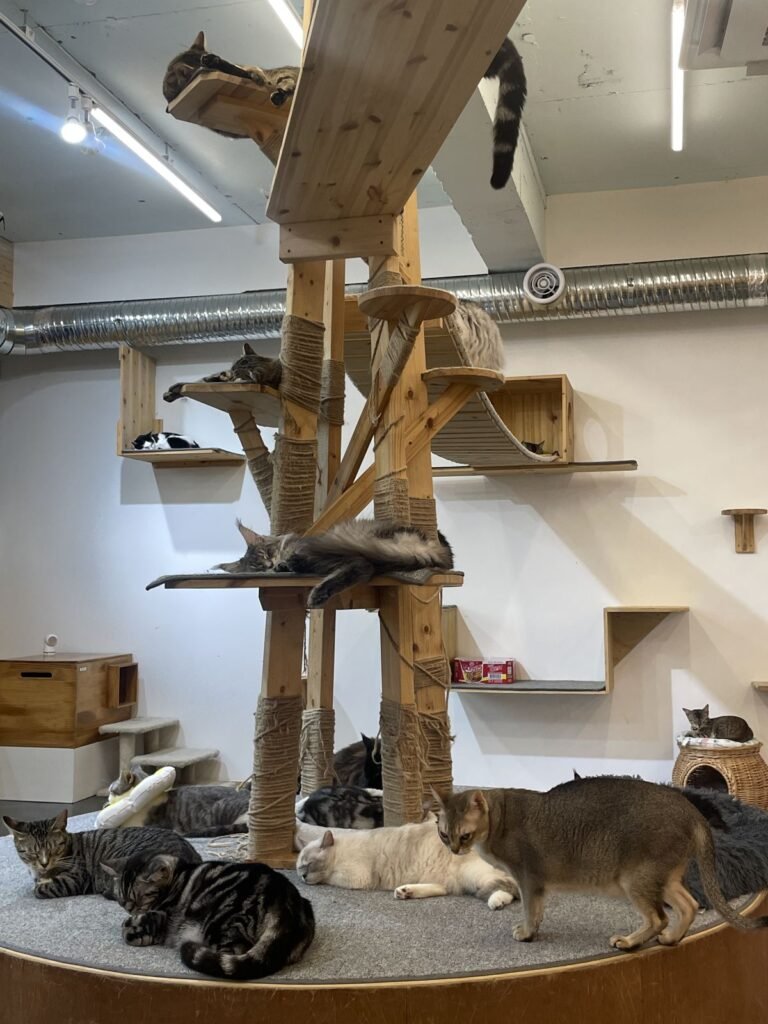
Seoul has a lot of cat cafés. Some are glossy, full of fluffy purebreds with Instagram accounts. The one I visited in Seongsu one September evening is different, and the difference is written in big letters at the entrance:
사지 말고 입양하세요. (saji malgo ibyanghaseyo.) — Don’t buy. Adopt.
The cats here are rescued street cats and abandoned pets, and every one of them is waiting for a home. The café is called 길고양이 마을 (gil goyangi maeul), “Stray Cat Town.” This post is about how it works, and the surprisingly rich Korean on its walls.
All the photos here are mine, from my visit in September 2026.
Finding it: look up
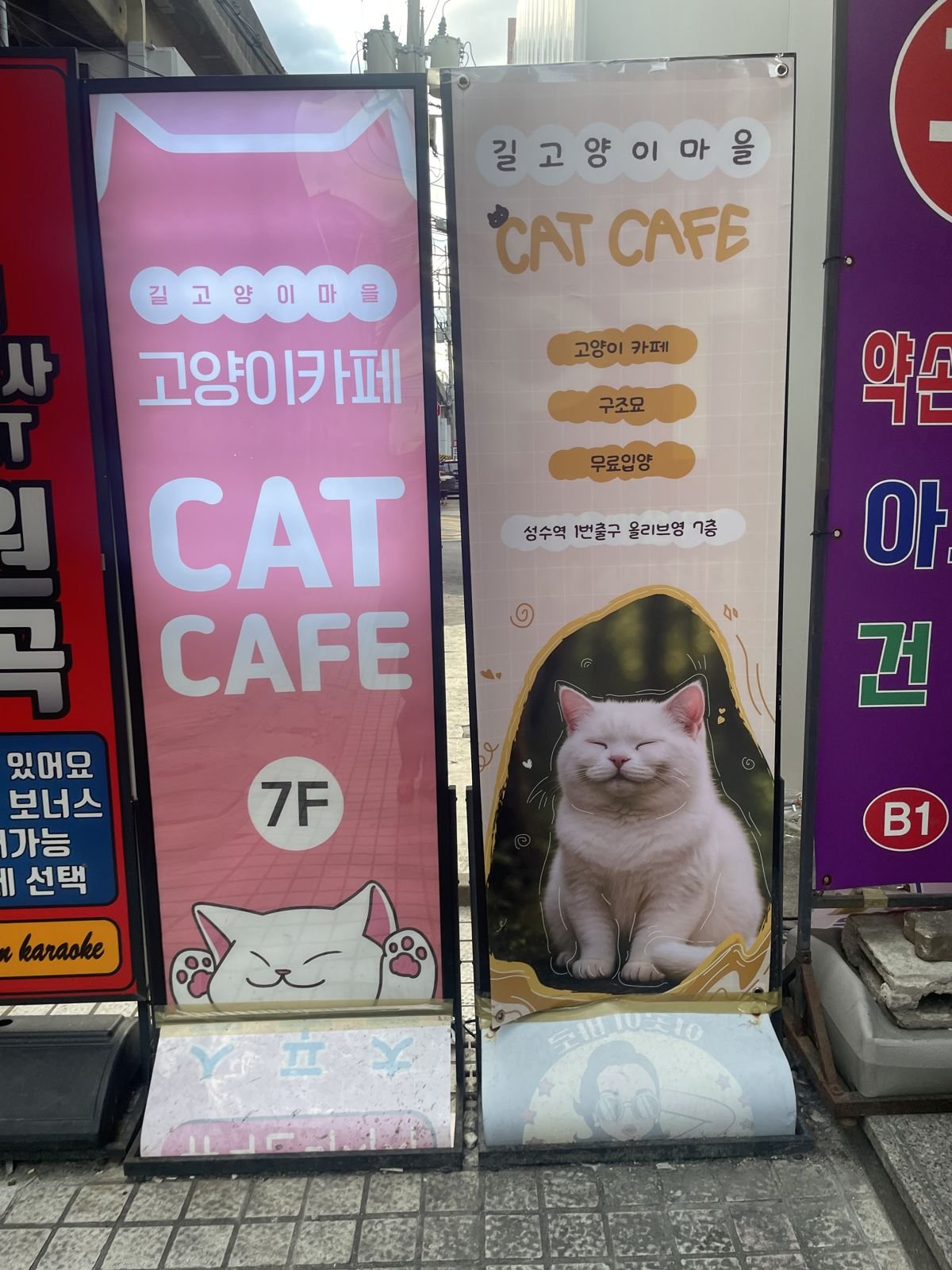
Like many places in Seoul, the café isn’t on the street. It’s upstairs. The banners outside say 고양이카페 (goyangi café), cat café, and 7F: the seventh floor. Korean buildings stack businesses vertically: a karaoke on one floor, a nail salon on another, a gym above that, and a cat café at the top. If you’re looking for something in Seoul and can’t find it, look at the floor numbers.
Useful phrase: 몇 층이에요? (myeot cheung-ieyo?) — “Which floor is it?”
층 (cheung) is floor. 7층 is 칠 층 (chil cheung).
The entrance: adopt, don’t shop

The sign by the door reads, in full:
KASCA와 함께하는 또 하나의 가족 찾기 — 유기·파양묘에서 반려묘로, 사지 말고 입양하세요.
“Finding another family member, with KASCA. From abandoned and returned cats to companion cats. Don’t buy, adopt.”
KASCA is the animal rescue group that runs the space. Three words from that sign are worth learning:
- 유기묘 (yugimyo) — an abandoned cat. 유기 means abandonment, and 묘 is the Sino-Korean syllable for cat.
- 파양묘 (payangmyo) — a cat that was adopted and then given back. 파양 means ending an adoption. It’s a sad word, and it’s very common in Korean animal-rescue language.
- 반려묘 (bannyeomyo) — a companion cat, a pet cat. 반려 means companion; a pet dog is a 반려견 (bannyeogyeon).
So the sign’s journey is: 유기묘 → 반려묘. From abandoned to loved.
Shoes off, slippers on

First, shoes off. You put your shoes in a numbered locker and change into the café’s slippers. Very Korean, and very sensible when the floor belongs to cats.
How you pay: a donation, not a ticket
Here’s what makes this place special. There’s no “entrance fee.” Instead, you become a 1일 보호자 (iril bohoja): a “one-day guardian.”

The notice explains it, and here’s the gist in English, as written when I visited:
- Hours: weekdays 11 AM to 10 PM; weekends and holidays 10 AM to 10 PM.
- The café runs on a “one-day donation”: you become the cats’ guardian for the day.
- You can choose your donation amount, and everyone gets the same service, whatever they give.
- The money goes to rescue, treatment, care and adoption of street cats.
- The guardian fee is per person. Cookies and snacks for humans are free; drinks are ordered separately.
- Time limit: none on weekdays; up to 2 hours on weekends and holidays.
And the most important line:
이곳의 모든 고양이는 어떠한 금전거래도 없이 입양이 가능하나, 엄격한 상담과 심사를 거쳐 입양이 진행됩니다.
“Every cat here can be adopted without any payment, but adoption goes through strict counseling and screening.”
Free to adopt, but not easy to adopt. That’s exactly how it should be.

At the kiosk, the options were 15,000 won, 20,000 won (with an eco bag) and 30,000 won (with a tumbler). A screen above the counter explains that donations of 20,000 won or more come with a thank-you gift. There were two of us, so we chose two 15,000-won guardian passes.
Kiosk words:
- 후원 (huwon) — donation, sponsorship
- 보호자 (bohoja) — guardian. It’s also the word a Korean vet or hospital uses for the person responsible for a patient.
- 입양 (ibyang) — adoption
Inside: three rooms
The space is divided into rooms, and a sign explains who lives where:

- 1번방 · 알리캣방 (alley cat room) — street-born cats, rescued and socialized but still a little shy and wild. Adults only.
- 2번방 · 고양이사랑방 — a resting room for cats in temporary foster care, or cats visitors brought with them.
- 3번방 · 유기묘, 파양묘방 — former house cats who were abandoned, returned or lost. The sign says many of them follow people around and are full of 애교 (aegyo): charm, cuteness.
낯가림 (natgarim) appears on the Room 1 sign too: shyness with strangers. A cat, or a toddler, or honestly a lot of adults with 낯가림 need time before they warm up.
The best sign in the building

This one made me laugh. It’s titled “주의! 여긴 생각보다… 현장감 넘칩니다!”: “Warning! It’s more… intense in here than you think!” Then:
These cats like people, but they’re still cats. When they’re in a bad mood: 냥냥펀치 (the cat punch). When they’re annoyed: 불시의 깨물기 (a surprise bite). And sometimes, for no reason at all: running, jumping and wall-climbing (!).
So the basic rule for visitors is “눈으로만 사랑해주기”: love them with your eyes only. People who want to go in and interact must be the kind of person who can laugh off a scratch, and must agree not to blame the shelter or the cats if they get hurt.
Two more slang words hide in the small print: 캣맘 (cat mom), someone who looks after street cats, and 캣덕후 (cat deokhu), a cat super-fan. I’ll come back to these, and more Korean cat words, in my next post.
Feeding time, with limits

You can buy snacks to feed the animals, but there’s a daily cap: 츄르 (churu), the lickable cat treat, is limited to 55 per day for the whole café (about one per cat), and the rabbit and guinea pig snacks to 60 per day.

A treat limit for the animals’ health. If only someone would do this for me at the convenience store. (Yes, there were rabbits and guinea pigs too.)
Words from the shelter
| Korean | Romanization | Meaning |
|---|---|---|
| 길고양이 | gil goyangi | Street cat |
| 유기묘 | yugimyo | Abandoned cat |
| 파양묘 | payangmyo | Cat returned after adoption |
| 반려묘 | bannyeomyo | Companion cat, pet cat |
| 입양 | ibyang | Adoption |
| 후원 | huwon | Donation |
| 보호자 | bohoja | Guardian |
| 낯가림 | natgarim | Shyness with strangers |
| 애교 | aegyo | Charm, cuteness |
A tiny conversation to practice
Staff: 1일 보호자 몇 분이세요?
iril bohoja myeot bun-iseyo? — How many one-day guardians?You: 두 명이요.
du myeong-iyo. — Two people.You: 여기 고양이들 입양할 수 있어요?
yeogi goyangideul ibyanghal su isseoyo? — Can the cats here be adopted?Staff: 네, 상담하고 심사를 거쳐야 해요.
ne, sangdamhago simsareul geochyeoya haeyo. — Yes, but you have to go through counseling and screening.
몇 분 (myeot bun) is the polite way to ask “how many people.” Staff will ask you this at almost every restaurant and café in Korea.
Why this place matters
A cat café can be just a fun hour with fluffy animals. This one is that, too. But every cat you meet has a story with a word attached: 길고양이, 유기묘, 파양묘. And every guardian fee goes toward a different word: 입양.
If you visit, love them with your eyes first. They’ll come to you when they’re ready.
Keep exploring