
Here is a fun fact about Korean clothing vocabulary: you already know half of it.
Cardigan. Padding. Coat. Knit. Korean borrowed a lot of fashion words from English, and some of them took a little detour along the way. A “one-piece” is a dress. “Padding” is a puffer jacket. And “mangto” is… we’ll get there.
All the photos here are mine, from an unmanned secondhand clothing shop inside a Seoul subway station. (I wrote about how those self-pay shops work in my last post.) Let’s go through the racks.
Before you look at the price tags: everything in this post is secondhand (vintage) clothing, so these are thrift-shop prices. New clothes in regular Korean shops, brand stores and department stores cost much more. Please don’t use these numbers to budget for new clothes in Korea!
The cardigan I bought: 가디건, 8,000 won
- 가디건 (cardigan) — cardigan. The standard spelling is actually 카디건, but you’ll see 가디건 everywhere, in shops and online. Both mean the same thing.
- 니트 (knit) — knitwear, any knitted top
- 단추 (danchu) — button

The tag says 8,000, which you read as 팔천 원 (palcheon won). Korean prices use the Sino-Korean numbers:
- 천 (cheon) — thousand
- 만 (man) — ten thousand
- 원 (won) — won, the currency
The tricky part for English speakers is 만. Korean counts big numbers in units of ten thousand, not one thousand. So 10,000 is not “ten thousand” but 만 원 (man won), “one ten-thousand won.” And 19,000 is 만 구천 원 (man gucheon won): one ten-thousand plus nine thousand.
Argyle and padding: 10,000 won each

This one is 10,000 won, 만 원 (man won). Pattern words you’ll see on Korean shopping sites:
- 아가일 (argyle) — argyle
- 체크 (check) — plaid, checked. Korean says “check” where many English speakers say “plaid.”
- 스트라이프 (stripe) or 줄무늬 (julmunui) — stripes

Now the famous one: 패딩 (padding). In Korea, 패딩 means a padded or puffer jacket, the thing almost everyone wears from November to March. A long one that reaches your knees is a 롱패딩 (long padding). This one has no sleeves, so it’s a 패딩 조끼 (padding jokki): 조끼 (jokki) means vest.
The fleece jacket: 19,000 won
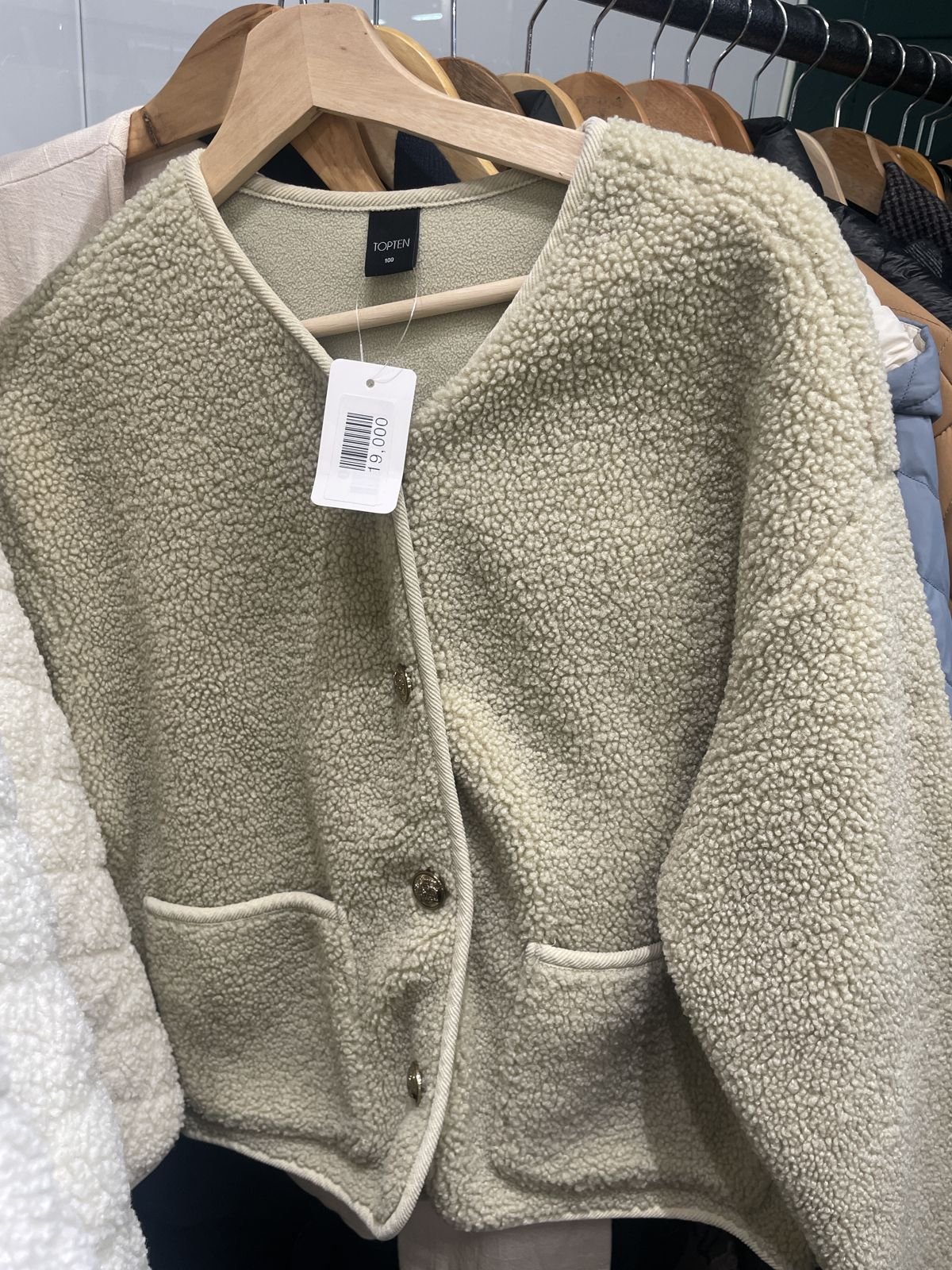
This fluffy jacket was 19,000 won, the most expensive thing I photographed. The fabric has its own Korean word:
- 뽀글이 (ppogeuri) — a casual word for a curly, fluffy fleece like this one. It comes from 뽀글뽀글 (ppogeul ppogeul), the sound-and-shape word for tightly curled things. Korean loves these. (If you like them, you’ll enjoy my post on Korean texture words.)
- 자켓 (jacket) — jacket. Also spelled 재킷, the standard form.
- 주머니 (jumeoni) — pocket
The one-piece and the coats

Here’s the classic Konglish surprise: a dress in Korean is a 원피스 (one-piece). Not a swimsuit. A dress, the kind that’s “one piece” from top to bottom. A skirt is 치마 (chima), and trousers are 바지 (baji).

The coat rack starts at 15,000 won: 만 오천 원 (man ocheon won). Coat words:
- 코트 (coat) — coat, a long tailored one
- 트렌치코트 (trench coat) — trench coat
- 점퍼 (jumper) — a casual jacket. In Korean, “jumper” means a jacket, not a sweater.
- 아우터 (outer) — outerwear in general. Shops love this word.
And the mystery word from the start: 망토 (mangto) is a cape or cloak, and it’s one loanword that didn’t come from English. You probably won’t need it. But now you know.
Clothing words in one place
| Korean | Romanization | Meaning |
|---|---|---|
| 옷 | ot | Clothes |
| 가디건 / 카디건 | cardigan | Cardigan |
| 니트 | knit | Knitwear |
| 패딩 | padding | Puffer jacket |
| 조끼 | jokki | Vest |
| 원피스 | one-piece | Dress |
| 치마 / 바지 | chima / baji | Skirt / Trousers |
| 코트 | coat | Coat |
| 점퍼 | jumper | Casual jacket |
| 단추 / 주머니 | danchu / jumeoni | Button / Pocket |
Prices you can now read (secondhand prices)
A quick reminder: these are the prices on the secondhand racks in this shop, not typical prices for new clothes in Korea. The point here is how to read them out loud.
| Price | Korean | Romanization |
|---|---|---|
| 5,000 won | 오천 원 | ocheon won |
| 8,000 won | 팔천 원 | palcheon won |
| 10,000 won | 만 원 | man won |
| 15,000 won | 만 오천 원 | man ocheon won |
| 19,000 won | 만 구천 원 | man gucheon won |
Phrases for the fitting
입어 봐도 돼요? (ibeo bwado dwaeyo?) — “Can I try it on?”
다른 사이즈 있어요? (dareun size isseoyo?) — “Do you have another size?”
이거 얼마예요? (igeo eolmayeyo?) — “How much is this?”
입다 (ipda) means “to wear” for clothes on your body. For shoes, Korean switches to 신다 (sinda), and for hats, 쓰다 (sseuda). One language, three verbs for “wear.”
A tiny conversation to practice
Friend: 그 가디건 예쁘다! 얼마였어요?
geu cardigan yeppeuda! eolmayeosseoyo? — That cardigan is pretty! How much was it?You: 팔천 원이요. 빈티지예요.
palcheon won-iyo. vintage-yeyo. — 8,000 won. It’s vintage.Friend: 진짜요? 저도 사고 싶어요!
jinjjayo? jeodo sago sipeoyo! — Really? I want to buy one too!
빈티지 (vintage) in Korean usually means secondhand or retro-style clothing, and a 빈티지 샵 (vintage shop) is a secondhand clothes store. Another loanword you already know.
The best souvenir
You can buy a lot of things in Seoul. But a secondhand mustard cardigan from a subway station, paid for by yourself at a kiosk, with the price read out loud in Korean? That’s a souvenir with a story.
팔천 원. Say it once, and it’s yours.
Keep exploring