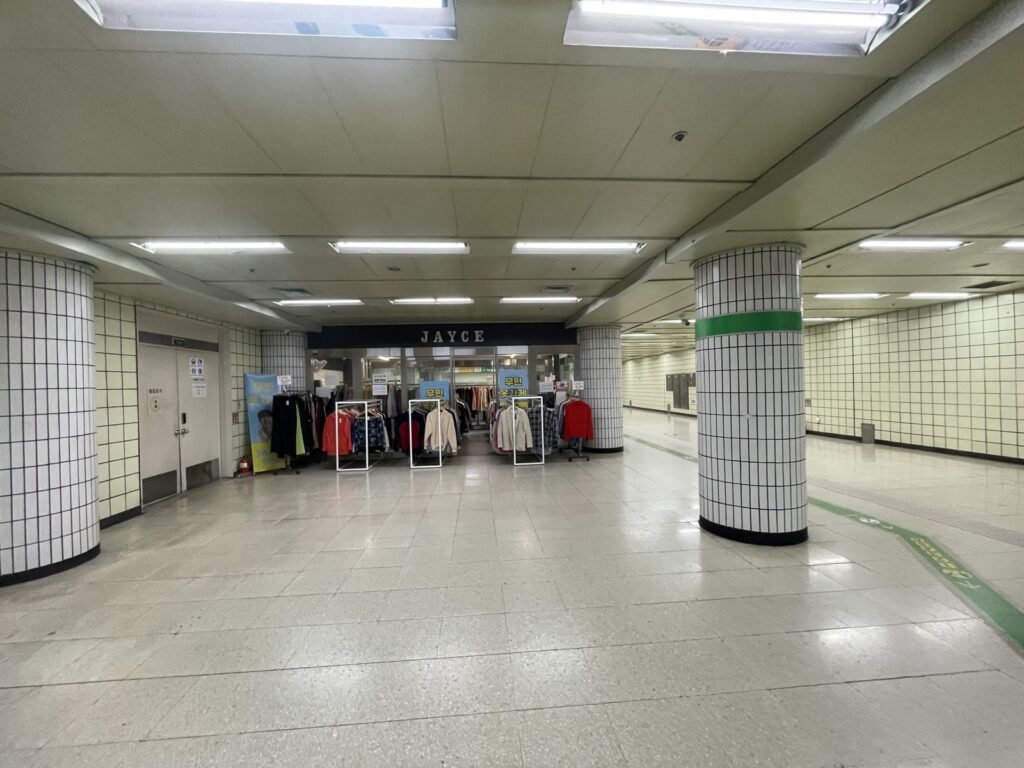
You’re walking through a subway station in Seoul. Tiled pillars, fluorescent lights, the usual rush. And then, between the exits, racks and racks of coats, cardigans and padded jackets. Price signs. A mirror.
No staff. Nobody at all.
Welcome to the 무인 매장 (muin maejang), the unmanned store. Korea has a lot of them: ice cream shops, stationery stores, photo booths, laundromats. And yes, secondhand clothing shops, sometimes right inside the subway.
These photos are from one I used inside a Seoul subway station. The station signs nearby say 충정로 (Chungjeongno). I’m not naming the shop. This post is about how these stores work, and the Korean you need to use one.
What 무인 means
무인 (muin) is made of two Sino-Korean parts: 무 (mu), “without,” and 인 (in), “person.” So 무인 = without people, unmanned. You’ll see it on signs like:
- 무인 매장 (muin maejang) — unmanned store
- 무인 아이스크림 (muin ice cream) — self-service ice cream shop
- 무인 옷가게 (muin otgage) — unmanned clothing store. 옷 (ot) is clothes and 가게 (gage) is shop.
The same 무 appears in 무료 (muryo), free of charge, literally “without a fee.” Two words for the price of one.
The price signs: 부터 and 가격표

One thing to keep in mind: this is a secondhand shop, so these are thrift prices, much lower than what new clothes cost in Korean stores.
The signs on each rack give a starting price, and every sign says the same thing in two languages:
- FROM 7,000 부터 — “from 7,000 won.” 부터 (buteo) means “from” or “starting at.” It comes after the number in Korean: 7,000원부터 (chilcheon won-buteo).
- 가격표 확인해주세요 (gagyeokpyo hwaginhae juseyo) — “Please check the price tag.” 가격 (gagyeok) is price, 표 (pyo) is tag or ticket.
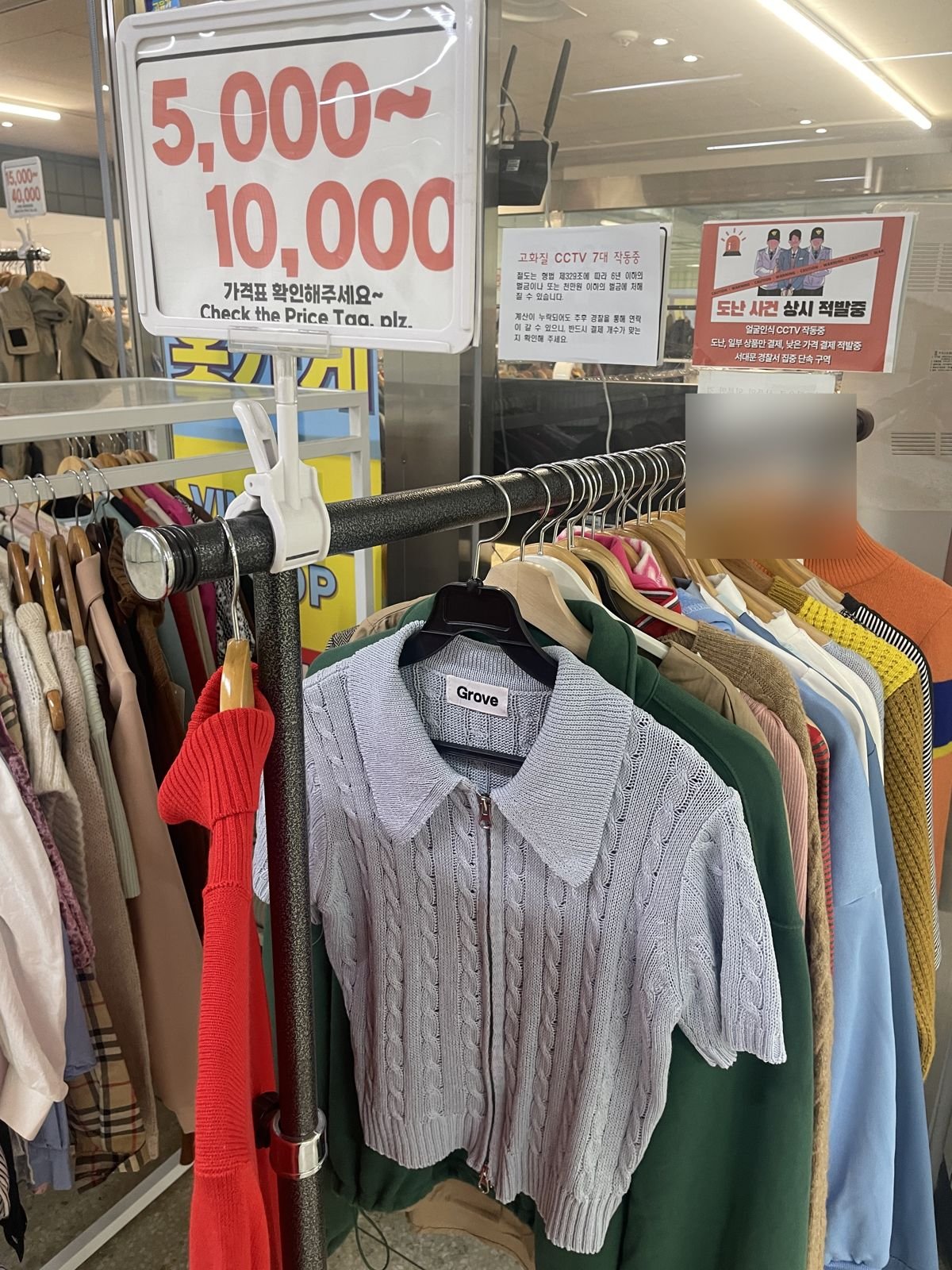
The sign above reads 5,000~10,000: a range. Out loud, you’d say 오천 원에서 만 원까지 (ocheon won-eseo man won-kkaji), “from 5,000 to 10,000 won.” 에서 (eseo) means “from” and 까지 (kkaji) means “to” or “until.”
Paying: the five steps on the wall
Since there’s nobody to take your money, you pay at a kiosk. Next to it, someone has kindly taped up the instructions, in red and black:

Here they are, translated. This is genuinely useful Korean: the same verbs appear on kiosks all over the country.
- 상품 스캔하기 (sangpum scan-hagi) — Scan the item. Hold the barcode on the price tag up to the barcode reader at the bottom right of the kiosk.
- 카드 결제 누르기 (card gyeolje nureugi) — Press “card payment.” Touch the [카드] button on the screen.
- 봉투 선택하기 (bongtu seontaekhagi) — Choose a bag. 봉투 is a bag, and you’ll usually be asked whether you want one.
- 카드 꽂기 (card kkotgi) — Insert your card. 꽂다 (kkotda) means to insert or stick something in.
- 영수증 받기 (yeongsujeung batgi) — Take your receipt.
Notice the pattern? Every step ends in -기 (-gi). Adding -기 to a verb turns it into a noun-like “doing X”: 스캔하기, scanning; 받기, receiving. It’s how Korean writes checklists, recipes and instructions. Once you see it, you’ll find it on every kiosk.
The sign also says, in English: “This is a Self-Pay store. Please pay by cash or bank transfer.” The kiosk itself takes cards, too, and it has a spot for phone payments.

When I paid, the screen showed 카드를 넣어주세요 (card-reul neoeojuseyo), “Please insert the card,” along with the amount to pay: 결제하실 금액 (gyeoljehasil geumaek), 8,000 won.

At the end: 영수증을 확인해 주세요 (yeongsujeung-eul hwaginhae juseyo), “Please check your receipt.” And that was it. A mustard cardigan, 8,000 won, no conversation required. (More on what I found on the racks in my next post.)
The other signs: CCTV is watching
Unmanned doesn’t mean unwatched. The walls of this shop make that very, very clear.
- 고화질 CCTV 7대 작동중 (gohwajil CCTV ilgop dae jakdongjung) — “7 high-definition CCTV cameras in operation.” 대 (dae) is the counter for machines; 작동중 means “currently operating.”
- 얼굴인식 CCTV 작동중 (eolgul insik CCTV jakdongjung) — “Face-recognition CCTV in operation.”
- 도난 사건 상시 적발중 (donan sageon sangsi jeokbaljung) — roughly, “Thefts are being caught at all times.”
One notice also warns that paying for only some items, or paying a lower price, is being caught too. The message is clear: scan everything, check your receipt, and the system trusts you.
This mix of trust and cameras is very Korean. The store sits open in a public passage with no one inside, and it works, mostly, because people pay. The cameras are there for the “mostly.”
Words for self-pay shopping
| Korean | Romanization | Meaning |
|---|---|---|
| 무인 매장 | muin maejang | Unmanned store |
| 가격표 | gagyeokpyo | Price tag |
| ~부터 | -buteo | From, starting at |
| 결제 | gyeolje | Payment |
| 봉투 | bongtu | Bag |
| 영수증 | yeongsujeung | Receipt |
| 금액 | geumaek | Amount |
| 작동중 | jakdongjung | In operation |
A tiny conversation to practice
Friend: 여기 직원 없어요?
yeogi jigwon eopseoyo? — Is there no staff here?You: 네, 무인 매장이에요. 키오스크에서 결제해요.
ne, muin maejang-ieyo. kiosk-eseo gyeoljehaeyo. — Right, it’s an unmanned store. You pay at the kiosk.Friend: 이 카디건 얼마예요?
i cardigan eolmayeyo? — How much is this cardigan?You: 가격표 보세요. 팔천 원이에요!
gagyeokpyo boseyo. palcheon won-ieyo! — Look at the price tag. It’s 8,000 won!
직원 (jigwon) means staff or employee. 없어요 (eopseoyo), “there isn’t,” is one of the first words you’ll need in Korea, and in a 무인 매장 it’s the whole point.
Why I love these places
A secondhand clothing store in the middle of a subway station, with nobody guarding the racks. It sounds impossible. In Seoul, it’s ordinary.
If you find one, try it. Read the five steps out loud. Scan, press, choose, insert, receive. You’ll walk out with a bargain and a little more Korean than you came in with.
Keep exploring