
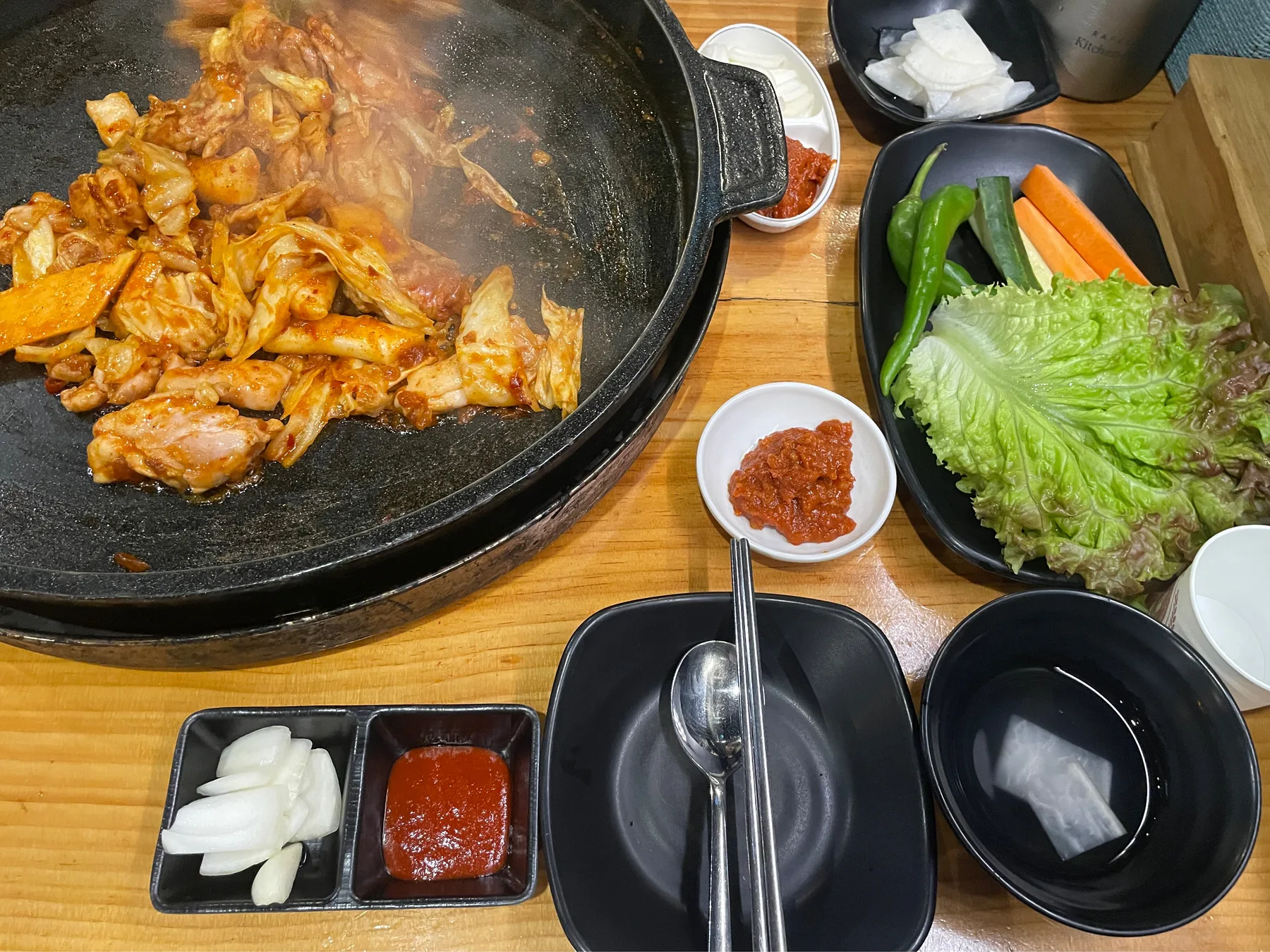
A large sizzling pan arrives at the table. There’s chicken, cabbage, maybe sweet potato and rice cakes, all getting to know a very red sauce. Welcome to dakgalbi (닭갈비).
If you’re visiting Korea, ordering it can feel like part meal, part small group project. Good news: you only need a handful of Korean phrases to handle the delicious parts.
What is dakgalbi?
The familiar iron-pan style combines chicken and vegetables with a spicy sauce; other styles, including charcoal-grilled versions, also exist. The dish is strongly associated with Chuncheon, though you’ll find dakgalbi restaurants elsewhere in Korea too.
Not every restaurant cooks or serves it the same way, so treat what you see at the table as your guide—not as a test of your Korean food expertise.
1. Start with your order
닭갈비 2인분 주세요.
Dakgalbi i-inbun juseyo.
“Two portions of dakgalbi, please.”
인분 means a portion for one person. If you’re dining alone, check the minimum order: some places require more than one portion.
2. Worried about the spice?
덜 맵게 해 주실 수 있어요?
Deol maepge hae jusil su isseoyo?
“Could you make it less spicy?”
It’s a request, not a guarantee. Some kitchens can adjust the heat; others prepare a fixed sauce. Asking before ordering is the safer move.
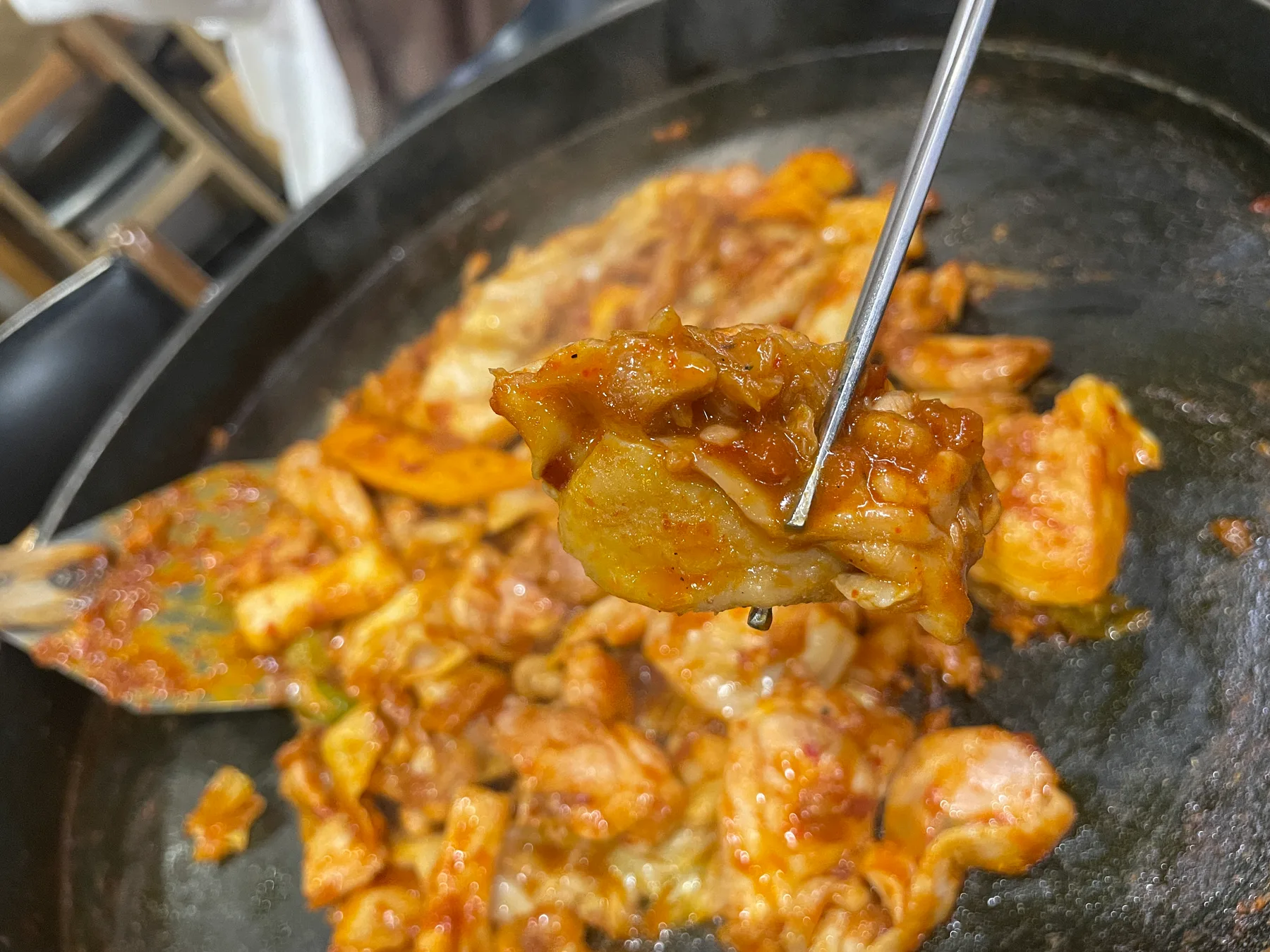
3. Is it ready to eat?
다 익었나요?
Da igeonnayo?
“Is it fully cooked?”
Especially useful when food is cooking at the table. Don’t guess whether the chicken is ready based on the color of the sauce.
Who stirs the pan?
At many iron-pan dakgalbi restaurants, staff come by to stir the pan and tell you when it’s ready. At others, you’re handed the spatula and trusted with the job. If you’re not sure which kind of place you’re in, it’s fine to ask:
저희가 볶으면 돼요?
Jeohui-ga bokkeumyeon dwaeyo?
“Should we stir it ourselves?”
The red sauce likes to jump. Some restaurants keep aprons for customers, so if you’re wearing something you love, try:
앞치마 있어요?
Apchima isseoyo?
“Do you have an apron?”
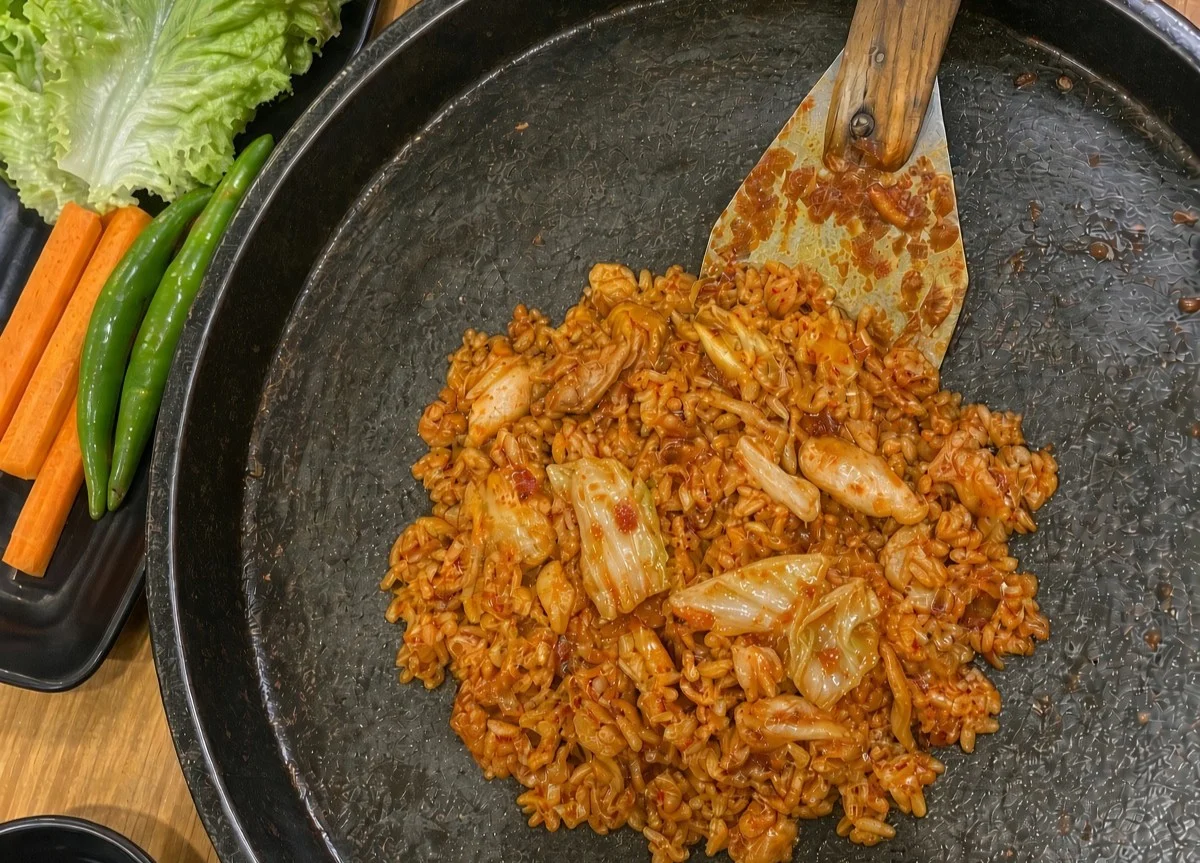
4. The plot twist: fried rice
At many iron-pan dakgalbi places, you can order 볶음밥 (bokkeumbap) after the chicken. Rice is fried with the sauce left in the pan. It’s an optional extra, not an automatic part of every meal—but it is a very satisfying way to finish.
볶음밥 하나 추가해 주세요.
Bokkeumbap hana chuga hae juseyo.
“One fried rice, please.”
Add-ons: what does 사리 (sari) mean?
On a dakgalbi menu you’ll often see a short list of extras ending in 사리 (sari). In restaurant Korean, sari means an add-on portion of noodles or other extras that goes into the shared pan. What’s offered depends on the restaurant, but these are common:
- 떡사리 (tteok-sari): extra rice cakes
- 치즈사리 (chijeu-sari): cheese
- 우동사리 (udong-sari): udon noodles
- 라면사리 (ramyeon-sari): instant noodles
To add one, use the same pattern as the fried rice:
치즈사리 하나 추가해 주세요.
Chijeu-sari hana chuga hae juseyo.
“One cheese add-on, please.”
That one word, 추가 (chuga), “add,” will get you a long way in Korean restaurants.
Menu words to know
| Korean | Romanization | Meaning |
|---|---|---|
| 닭갈비 | dakgalbi | spicy stir-fried chicken |
| 철판 | cheolpan | iron pan (cooked at the table) |
| 숯불 | sutbul | charcoal grill |
| 1인분 / 2인분 | il-inbun / i-inbun | one portion / two portions |
| 사리 | sari | add-on (noodles, rice cakes, cheese) |
| 볶음밥 | bokkeumbap | fried rice |
| 공기밥 | gonggibap | a bowl of plain rice |
| 막국수 | makguksu | buckwheat noodles, another Chuncheon specialty |
If you ever take the train to Chuncheon, the city most associated with dakgalbi, look for 닭갈비골목 (dakgalbi golmok), “dakgalbi alley.” 골목 (golmok) means a side street or alley, and in Korea a street named after one food usually means many restaurants serving it side by side. Pair the meal with a bowl of makguksu and you’ve had the classic Chuncheon combination.
Small requests at the table
Side dishes and water are part of the meal in most Korean restaurants. Some places bring refills when you ask; others have a self-service corner, often marked 셀프 (selpeu), “self.”
- 물 좀 주세요. (Mul jom juseyo.): Some water, please.
- 반찬 좀 더 주세요. (Banchan jom deo juseyo.): Could we have more side dishes?
- 저기요! (Jeogiyo!): Excuse me! (to call staff)
Paying at the end
In many Korean restaurants you pay at the counter on your way out, not at the table. Bring the bill if there’s one on your table, and say:
계산할게요.
Gyesanhalgeyo.
“I’d like to pay.”
If you’re splitting the bill, 따로 계산해 주세요 (ttaro gyesanhae juseyo) means “please charge us separately.” Not every restaurant splits bills, so ask before the card comes out.
A tiny conversation to practice
You: 닭갈비 2인분 주세요.
Staff: 네.
You: 덜 맵게 해 주실 수 있어요?
Staff: 확인해 볼게요. (I’ll check.)
Simple, useful, and enough to make dinner feel less intimidating. Sometimes the best Korean practice starts with being hungry.
Keep exploring