Korean fried chicken has its own vocabulary, and the menu can feel like a quiz: 순살 or 뼈? 양념 or 간장? Why does everyone say 치맥? I learned a few new words myself at a chicken shop in Seoul whose sign proudly says 대구 3대 통닭, “one of Daegu’s top three chickens.” Here’s the Korean you need to order chicken like a local.

“3대” restaurants: a very Korean boast
You’ll see 3대 (sam-dae) on signs all over Korea: 3대 맛집, 3대 빵집, 3대 통닭. It means “one of the top three” of something, and it’s a common way for restaurants to say they’re famous. There’s no official list behind it, so read it as a proud slogan.
통닭 (tongdak) literally means “whole chicken,” from 통 (whole) and 닭 (chicken). It’s an older, nostalgic word for fried chicken, and many shops use it to sound classic. Today you’ll hear 치킨 (chikin) more often, but both mean the same delicious thing.
순살 or 뼈: boneless or bone-in?
The first choice on most chicken menus:
- 순살 (sunsal): boneless. 순 means “pure,” 살 means “meat, flesh.”
- 뼈 (ppyeo) or 뼈닭 (ppyeodak): bone-in. 뼈 means “bone.”
I went boneless. To say it: 순살로 주세요 (Sunsal-lo juseyo), “Boneless, please.”

The flavors: 후라이드, 양념, 간장 and more
| Korean | Romanization | What it is |
|---|---|---|
| 후라이드 | huraideu | plain fried, crispy, no sauce |
| 양념 | yangnyeom | sweet and spicy red sauce |
| 간장 | ganjang | soy sauce glaze |
| 반반 | banban | half and half, two flavors in one order |
| 파닭 | padak | chicken topped with shredded green onion |
| 마늘 | maneul | garlic |
후라이드 is the English word “fried,” written the way Koreans say it. 양념 (yangnyeom) literally means “seasoning,” but on a chicken menu it always means the red, sticky, sweet-spicy sauce. And 반반 (banban), “half-half,” is the answer if you can’t decide.
The shop’s signature is 삼미통닭 (Sammi Tongdak). 삼 means three and 미 means taste, and the poster explains the three: 꿀, 청양고추, 마늘, honey, cheongyang chili and garlic.
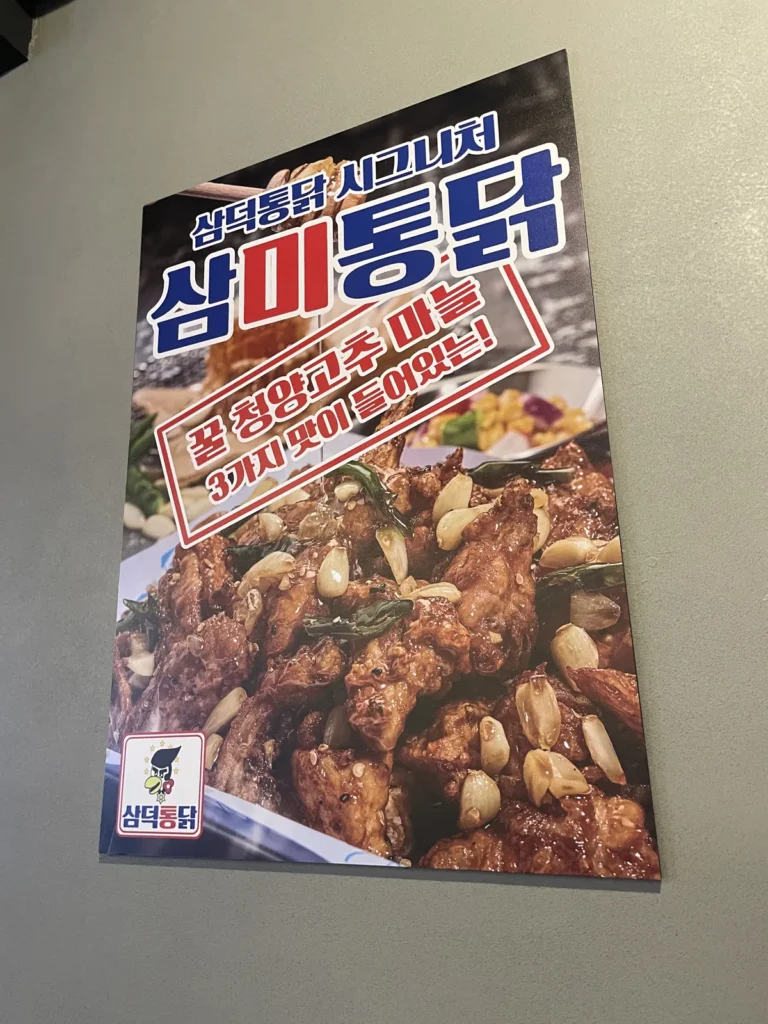
청양고추 (cheongyang gochu) is a small, hot green chili, and Korean menus mention it to warn you, or tempt you. If you’re careful with spice, ask: 많이 매워요? (Mani maewoyo?), “Is it very spicy?”
The skewer: 쫀득 감자 치킨
I also tried something new to me: a skewer of chicken in a potato batter, crispy outside and chewy inside. The kiosk calls it 쫀득 감자 치킨, shortened to 쫀감치.

Two words worth stealing from that name:
- 쫀득 (jjondeuk): chewy in a good, springy way, like mochi
- 겉바속촉 (geotbasokchok): short for 겉은 바삭, 속은 촉촉, “crispy outside, moist inside.” It’s a favorite food-review word, and exactly how this skewer tasted.
Koreans love shortening long phrases like this. 쫀감치 and 겉바속촉 are both made by taking the first syllable of each word.
What comes with the chicken

Korean chicken almost always arrives with small sides:
- 치킨무 (chikin-mu): cubes of sweet pickled radish, a palate cleanser between bites
- 양배추 샐러드 (yangbaechu saelleodeu): shredded cabbage with dressing
- 소스 (soseu): extra dipping sauce
Need more? 치킨무 좀 더 주세요 (Chikin-mu jom deo juseyo), “More pickled radish, please.” At kiosk restaurants, extras like rice or noodles may be under 사리 & 소스, the add-ons menu.

치맥: chicken and beer
치맥 (chimaek) is 치킨 + 맥주 (beer), the most famous food pairing in Korea. Chicken shops usually sell 생맥주 (saengmaekju), draft beer, and the sign outside this shop advertised it too. A 500ml glass is often called 오백 (obaek), “five hundred.”
Take it home: 포장

Can’t finish? Korean chicken shops are used to it. Say 남은 거 포장해 주세요 (Nameun geo pojanghae juseyo), “Please pack the rest to go.” And of course, chicken delivery, 배달 (baedal), is a whole culture of its own in Korea.
Order like this
순살 양념 하나랑 생맥주 두 잔 주세요.
Sunsal yangnyeom hana-rang saengmaekju du jan juseyo.
“One boneless yangnyeom chicken and two draft beers, please.”
Swap 양념 for any flavor on the menu, and you’re set.
Menu names are from the shop’s posters and kiosk in November 2026.
Keep exploring