
Here is a scene I know well from teaching.
A student has practiced the café dialogue from the textbook. They can say it in their sleep. They walk up to a real counter in Seoul, deliver their line beautifully — and the barista answers with something that was not in the textbook.
Silence. A small, polite smile. The slow backward drift toward the door.
If that’s you, welcome. You’re in very good company. The fix is not more vocabulary. The fix is knowing what the barista is going to say back.
Every photo in this post is my own, taken at three cafés I keep going back to in Gangnam, around Apgujeong and Sinnonhyeon. Real menus, real counters, real drinks.
First, a little context: Korea runs on coffee
In many Seoul neighborhoods you can stand on one corner and count several cafés. Koreans even have a word for the people who move into one for the afternoon with a laptop, a charger, and a single drink they will make last for three hours: 카공족 (kagongjok), the “café-study tribe.”
So you will order coffee here. Often. Let’s make it painless.
The only sentence you truly need
아이스 아메리카노 한 잔 주세요.
ice americano han jan juseyo
“One iced americano, please.”
That’s it. That’s the spell. Three parts:
- 아이스 아메리카노 — good news: most café drinks are just English wearing a Korean coat. Latte is 라떼 (latte). Cappuccino is 카푸치노 (cappuccino). Say the English name slowly and with confidence, and you’ll be understood far more often than you fear.
- 한 잔 (han jan) — “one cup.” Two is 두 잔 (du jan), three is 세 잔 (se jan). (Yes, Korean has two number systems. No, you don’t need to worry about the other one today.)
- 주세요 (juseyo) — “please give me.” If Korean had a Swiss Army knife, this would be it. Coffee, water, the bill, a napkin, mercy — 주세요 covers all of it.
Want it hot? Swap 아이스 for 따뜻한 (ttatteuthan, “warm”): 따뜻한 아메리카노 한 잔 주세요.
How to read a Korean café menu
Before you even open your mouth, there’s the menu. Here’s one from a café I like — and it’s a great little Korean lesson all by itself.
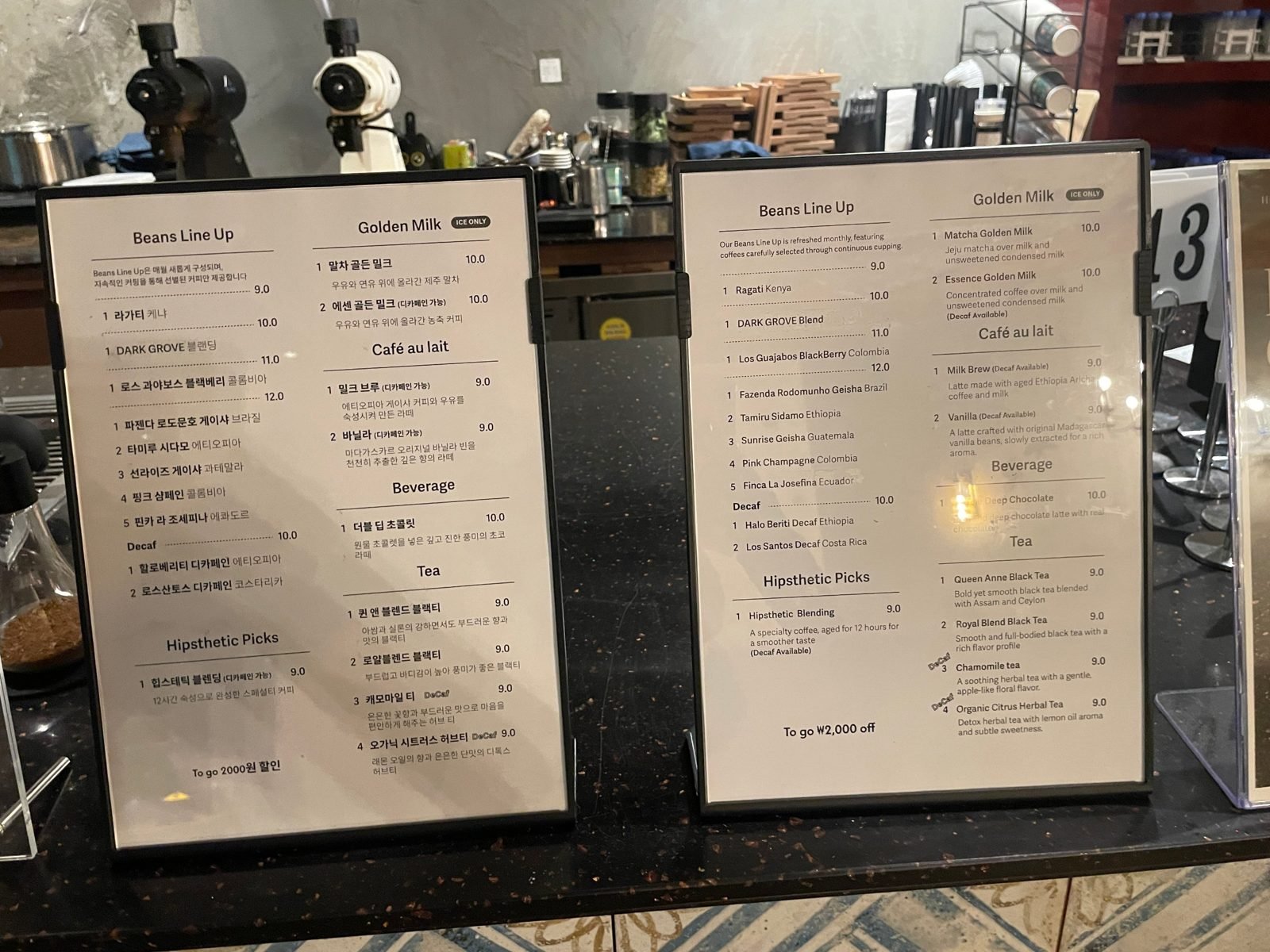
Four things to notice:
1. “9.0” does not mean nine dollars. Korean café menus often drop the last three zeros. 9.0 means ₩9,000. 6.5 means ₩6,500. Nobody is trying to sell you a nine-won latte. (Sadly.)
2. 디카페인 가능 (decaf ganeung) = decaf available. 가능 means “possible,” and it’s a wonderfully useful word. You’ll see it everywhere: 카드 가능 (card OK), 포장 가능 (takeout OK).
3. ICE ONLY. Some drinks come only one way. If you ask for a hot one, you may hear 아이스만 돼요 (ice-man dwaeyo) — “it only comes iced.”
4. “To go 2000원 할인.” 할인 (harin) means discount. At this café, when I took this photo, taking your drink with you knocked ₩2,000 off the price. Remember this when we get to the “here or to go?” question below. Your answer might literally be worth money.
The part the textbook skipped: what the barista says back
You’ve said your sentence. Now comes the counterattack. Here are the questions you’re most likely to hear, roughly in the order they arrive.

1. The speed round: “Here or to go?”
드시고 가세요? (deusigo gaseyo?) — “Will you have it here?”
가져가세요? (gajyeogaseyo?) — “Will you take it with you?”
In real life these often come out together, at the speed of someone who has said them four hundred times today:
deusigo-gaseyo-gajyeogaseyo?
It sounds like one very long word. It is not a test. It is not a riddle. It is just “here or to go?” Pick a side:
- 여기서 먹을게요. (yeogiseo meogeulgeyo) — “I’ll have it here.”
- 가져갈게요. (gajyeogalgeyo) — “I’ll take it with me.” (Possibly ₩2,000 cheaper. See above.)
- Or the lazy-but-perfect versions: 매장이요 (maejang-iyo, “in-store”) / 포장이요 (pojang-iyo, “to go”).
2. “Size?”
사이즈는요? (size-neunyo?)
Café size names are a small chaos of their own, and many chains invent their own. Do what Koreans do: point at the menu. Or say 작은 거 (jageun geo, “the small one”) / 큰 거 (keun geo, “the big one”). Pointing is a universal language, and baristas are fluent in it.
3. “Points?”
적립하시겠어요? (jeongnipasigesseoyo?)
or 포인트 있으세요? (point isseuseyo?)
This is the one that ambushes people. Many Korean cafés run stamp cards or app points, so you’ll hear this a lot. You do not have points. You have never had points. Here is your escape hatch:
아니요, 괜찮아요. (aniyo, gwaenchanayo) — “No, it’s okay.”
Tattoo this on your heart. 괜찮아요 means “it’s fine,” and it politely declines almost anything: points, a bag, a straw, a receipt, an offer to sign up for something you don’t understand.
4. “Receipt?”
영수증 드릴까요? (yeongsujeung deurilkkayo?)
You already know the answer. 네 (ne, “yes”) — or, say it with me — 아니요, 괜찮아요.
Drinks you won’t find back home
Here’s where Korean cafés get fun. Look at this menu board from another café:
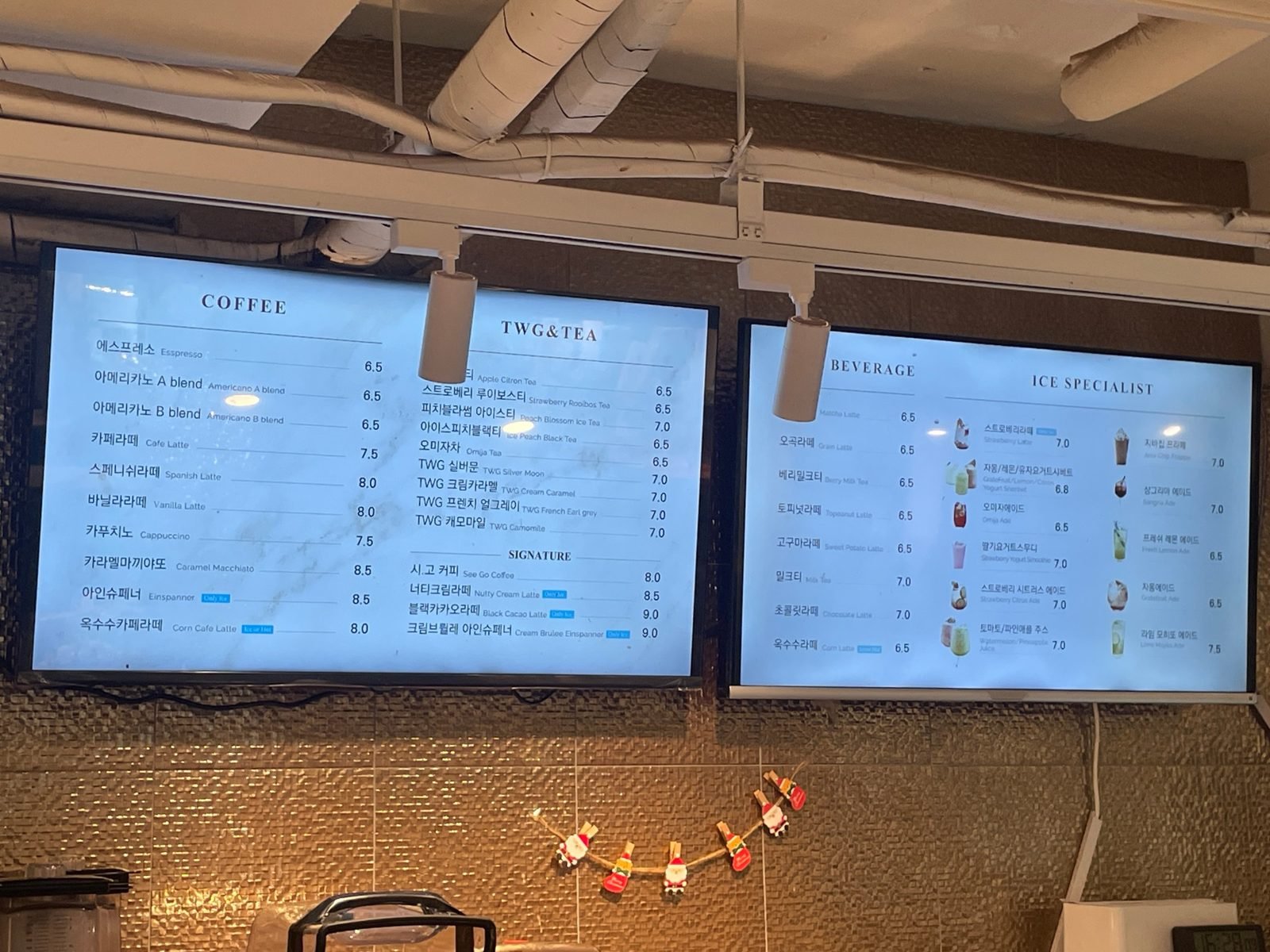
A few that deserve your curiosity:
- 오곡라떼 (ogok latte) — “five-grain latte.” A warm, nutty drink made with roasted grains. Tastes like a cozy breakfast cereal decided to become a beverage.
- 고구마라떼 (goguma latte) — sweet potato latte. Thick, sweet, and much better than it sounds.
- 옥수수라떼 (oksusu latte) — corn latte. I will not try to convince you. I will only say: try it once.
- 아인슈페너 (Einspänner) — an Einspänner: coffee with a thick cream cap. You’ll see it on many Korean café menus.
- 오미자 (omija) — schisandra berry, whose name literally means “five flavors.” Sweet, sour, a little bitter. Find it as 오미자차 (tea) or 오미자에이드.
- 에이드 (ade) — “ade.” In Korean cafés this means a fizzy fruit drink, like 자몽에이드 (jamong ade, grapefruit ade) or 레몬에이드.
To order any of them, you already know the spell: 오곡라떼 한 잔 주세요.
Customizing like a regular
Once the basic order stops feeling like a performance, you can start making demands. Politely.
| You want | Say | Romanization |
|---|---|---|
| An extra shot (it’s been a day) | 샷 추가해 주세요 | shot chuga-hae juseyo |
| Weaker coffee | 연하게 해 주세요 | yeonhage hae juseyo |
| No syrup | 시럽 빼 주세요 | syrup ppae juseyo |
| Less sweet | 덜 달게 해 주세요 | deol dalge hae juseyo |
| Less ice (more coffee, you clever thing) | 얼음 조금만 주세요 | eoreum jogeumman juseyo |
| Do you have decaf? | 디카페인 있어요? | decaf isseoyo? |
| Can I pay by card? | 카드 돼요? | card dwaeyo? |
Spot the pattern: ~해 주세요 (hae juseyo), “please do ~ for me.” Once you see it, you’ll see it everywhere — and you can build your own requests on the spot.
At a hand-drip bar: the acidity question
Some Seoul cafés are serious about beans. You’ll know you’re in one when the counter looks like this:

Each card is a mini reading test. The labels you’ll see in Korean:
- 원두 (wondu) — coffee beans · 원두명 — bean name
- 생산지역 (saengsan jiyeok) — growing region
- 품종 (pumjong) — variety
- 가공방식 (gagong bangsik) — processing method
And here’s the question that surprises people at bars like this:
산미 있는 거 좋아하세요? (sanmi inneun geo joahaseyo?) — “Do you like coffee with acidity?”
산미 (sanmi) is acidity — the bright, fruity side of coffee. Your two answers:
- 산미 있는 거로 주세요. (sanmi inneun georo juseyo) — “Something with acidity, please.”
- 고소한 거로 주세요. (gosohan georo juseyo) — “Something nutty and roasty, please.”
고소하다 (gosohada) is one of those Korean words English struggles with: toasty, nutty, comforting — the taste of roasted sesame or fresh popcorn. Koreans use it for coffee, fresh bread, sesame oil and roasted nuts.
Still not sure? 추천해 주세요 (chucheonhae juseyo) — “Please recommend one.” Then let the barista enjoy their moment.
The kiosk: a touchscreen that will not wait for you
Many cafés now take orders at a kiosk. Some offer English; some don’t. The kiosk is very patient right up until it isn’t, and then it quietly resets to the home screen while you’re still deciding about oat milk.
Six words will get you through:
- 매장 (maejang) — eat in
- 포장 (pojang) — take out
- HOT / ICE — usually in English, thankfully
- 옵션 (option) — options (size, shots, syrup)
- 담기 (damgi) — add to cart
- 결제 (gyeolje) / 결제하기 — pay
And if the kiosk wins this round? Walk to the counter and say 주문할게요 (jumunhalgeyo, “I’d like to order”). Staff are used to it.
Waiting for your drink: buzzers and numbers
In many cafés you’ll be handed a small disc. Do not put it in your pocket and forget about it. That’s a 진동벨 (jindongbel), a “vibrating bell,” and when your drink is ready it will buzz, flash, and possibly scoot across the table like it’s trying to escape. Carry it back to the counter like a trophy.
Other cafés skip the buzzer. You might get a little number stand to put on your table (look closely at the counter photo above — there’s one waiting), or the barista will simply call your number or bring the drink over.
Coffee comes with dessert
In Korea, a café visit and a dessert visit are often the same visit.

Ordering it is easy — point and use your new favorite word:
- 이거 하나 주세요. (igeo hana juseyo) — “One of these, please.”
- 케이크 하나 주세요. (cake hana juseyo) — “One cake, please.”
- 데워 주세요. (dewo juseyo) — “Please warm it up.” Useful for croissants and other pastries.
Notice 하나 (hana) here instead of 한 잔. 잔 is for cups. For a pastry, you just say one: 하나.
Café slang: the words that get you a smile
These aren’t on the menu, but you’ll hear them, and using one is a little like knowing the secret handshake:
- 아아 (a-a) — short for 아이스 아메리카노. Koreans love an abbreviation, and this one is iconic. Its hot sibling is 뜨아 (tteu-a), from 뜨거운 아메리카노.
- 얼죽아 (eoljuga) — short for 얼어 죽어도 아이스 아메리카노: “iced americano, even if I freeze to death.” It describes people who drink iced coffee all year round. In January. Outside. With conviction. You will meet many of them.
- 카공족 (kagongjok) — our café-study tribe from earlier.

My challenge for you: order 아아 한 잔 주세요 just once. Watch the barista’s face. That tiny smile is the sound of you being understood.
Practice: a café conversation in 30 seconds
Read it out loud, playing both parts (bonus points for doing the barista voice). Then cover the Korean and try again.
Barista: 어서 오세요. 주문하시겠어요?
eoseo oseyo. jumunhasigesseoyo? — Welcome. Ready to order?You: 아이스 라떼 한 잔 주세요.
ice latte han jan juseyo. — One iced latte, please.Barista: 드시고 가세요?
deusigo gaseyo? — For here?You: 아니요, 가져갈게요.
aniyo, gajyeogalgeyo. — No, to go.Barista: 적립하시겠어요?
jeongnipasigesseoyo? — Collecting points?You: 아니요, 괜찮아요. 카드 돼요?
aniyo, gwaenchanayo. card dwaeyo? — No, it’s okay. Can I pay by card?Barista: 네, 여기 꽂아 주세요.
ne, yeogi kkoja juseyo. — Yes, please insert it here.
Victory. Iced latte acquired.
Emergency kit: if you freeze anyway
It happens. To everyone. Even to people who studied. Keep these three in your back pocket:
- 다시 한번 말씀해 주세요. (dasi hanbeon malsseumhae juseyo) — “Could you say that again, please?”
- 천천히 말해 주세요. (cheoncheonhi malhae juseyo) — “Please speak slowly.”
- 이거 주세요. (igeo juseyo) + point firmly at the menu — “This one, please.”
That last one is not cheating. It is Korean. Korean people say it every day.
For more rescue phrases, here’s my guide to keeping a Korean conversation going when you freeze.
One last sip

A coffee order is small. But for a lot of learners, it’s the first time their Korean works out there in the real world: someone asks a question, you understand it, you answer — and a drink appears in your hand. Nothing in a textbook feels quite like that.
So tomorrow, around 4pm, walk up to the counter, take a breath, and say it:
아아 한 잔 주세요.
You’ve got this.
Keep exploring